Hammurabi
Mesopotamia · California History–Social Science 6.2
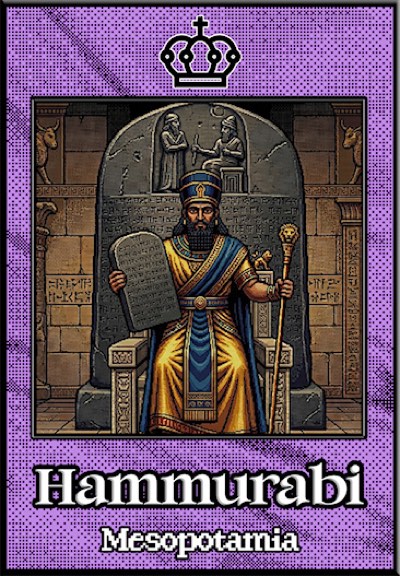
Hammurabi was a king of Babylon who ruled from about 1792 to 1750 BCE. He conquered the cities around Babylon and united much of Mesopotamia. Hammurabi is best known for his code, a collection of 282 laws. The laws were carved on a tall black stone so that people could know the rules and the punishments for breaking them. Many punishments matched the crime, an idea often called "an eye for an eye." But the laws were not equal for everyone. Punishments depended on whether a person was rich, poor or enslaved. The code covered trade, farming, families, building and much more. At the top of the stone, Hammurabi is shown standing before the sun god Shamash, the god of justice. The stone was found in 1901 and is now in the Louvre museum in Paris.
Key facts
- Hammurabi was a king of Babylon in Mesopotamia.
- His code had 282 laws, carved in stone for people to see.
- Punishments often matched the crime, but they were different for different social classes.
In the game
- Capital cost (CC)
- 5
- Influence Points (IP)
- 5
- Type
- Political
Eye For An Eye. At Once: Destroy your lowest-CC card here in order to destroy your opponent's lowest-CC card here.
How to earn it: Students beat Hammurabi in the Giant battle on the Mesopotamia map.