Rosetta Stone
Ancient Egypt · California History–Social Science 6.2
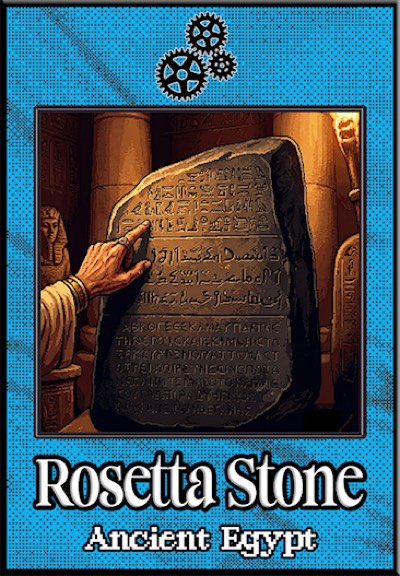
The Rosetta Stone is a broken slab of dark stone carved in 196 BCE. It holds a message from Egyptian priests honoring the king, Ptolemy V. What makes it special is that the same message is written three times, in three scripts: Egyptian hieroglyphs, a faster Egyptian script called Demotic, and ancient Greek. For hundreds of years, no one could read hieroglyphics. In 1799, French soldiers found the stone near the town of Rashid, which Europeans called Rosetta. Scholars could already read ancient Greek, so they used it as a key to work out the Egyptian writing. In 1822, a French scholar named Jean-François Champollion announced that he had cracked the code. Today the Rosetta Stone is in the British Museum in London.
Key facts
- The Rosetta Stone has the same message in hieroglyphs, Demotic and Greek.
- It was found in 1799 near the town of Rosetta (Rashid) in Egypt.
- It helped Jean-François Champollion decipher hieroglyphics in 1822.
In the game
- Capital cost (CC)
- 3
- Influence Points (IP)
- 3
- Type
- Scientific
Decipher The Past. At Once: Transcribes the text of the card in the first slot at this location to itself.
How to earn it: Students buy it for 15 gold at the River Market on the Egypt map. It unlocks once they've beaten Ramses.